



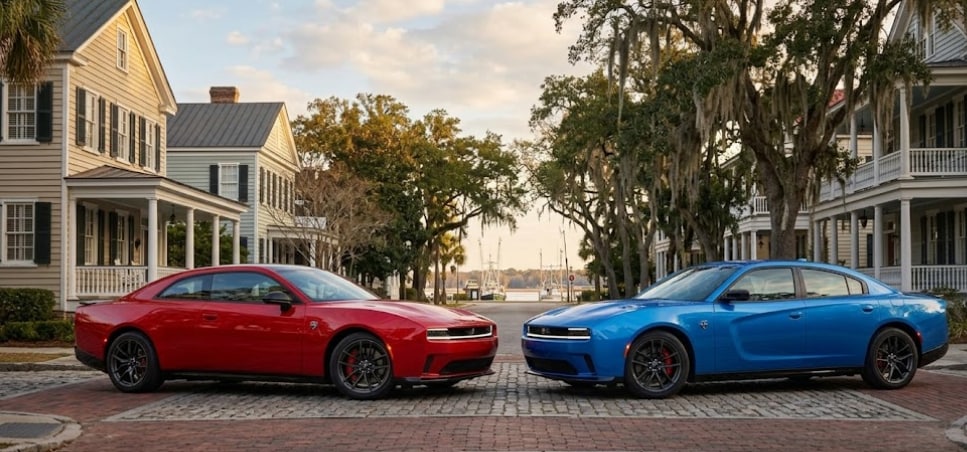
The Dodge Charger has changed dramatically, which means shoppers have more questions about it than ever.
Can you still buy one with a gas engine? Is the electric Charger better? Can a Charger tow? How much room is actually inside? And what happens to an electric Charger battery during a hot South Carolina summer?
At Butler Chrysler Dodge Jeep Ram in Beaufort, we put together answers to some of the most common questions shoppers are asking about the 2027 Dodge Charger. Whether you're shopping from Beaufort, Hilton Head, Bluffton, Charleston, Hinesville, or Savannah, here's what to know before deciding whether the next-generation Charger is right for you.
Can You Still Buy a Gas Dodge Charger?
Yes. The 2027 Dodge Charger is available with gasoline engines as well as an all-electric powertrain.
Gas-powered Charger R/T and Scat Pack models use Dodge's 3.0-liter twin-turbo SIXPACK straight-six engine.
The Charger R/T produces 420 horsepower and 468 lb-ft of torque, while the higher-output Charger Scat Pack produces 550 horsepower and 531 lb-ft of torque.
There's also a new performance model for 2027. Dodge has announced the 2027 Charger Super Bee Launch Edition, which increases output from the SIXPACK engine to a targeted 600 horsepower.
So no, you don't have to buy an electric Charger if you don't want one.
Another big change is traction. The gas-powered Charger comes standard with all-wheel drive, but drivers can switch into rear-wheel-drive mode when they want the more traditional feel of a rear-drive muscle car.
Dodge Charger Electric vs. Gas: Which Is Better?
Neither is automatically better. They're designed for different buyers.
Choose a gas-powered Charger R/T or Scat Pack if you prefer:
- Filling up at a gas station in minutes
- Traditional engine and exhaust sound
- Longer road trips without planning charging stops
- The feel of a twin-turbo performance engine
- Switchable AWD and RWD capability
Consider the Charger Daytona Scat Pack EV if you prefer:
- Instant electric torque
- 670 horsepower
- A 0-60 mph time around 3.3 seconds
- No gasoline
- Fewer routine powertrain maintenance requirements
- Home charging
For someone regularly driving between Beaufort and Charleston, either can work well. Drivers frequently taking long spontaneous road trips may find the SIXPACK easier to live with, while someone who can charge at home may appreciate the convenience and explosive acceleration of the Daytona.
What Colors Are Available on the 2027 Dodge Charger?
Dodge isn't exactly known for playing it safe with color.
Available 2027 Charger colors include:
- Bludicrous
- Green Machine
- White Knuckle
- Redeye
- Sub-Zero
- Diamond Black
- Purple Haze
Purple Haze is particularly noteworthy. Dodge created the limited-run color specifically for the Charger's 60th anniversary, and it is exclusive to the 2027 model year.
Depending on the model, buyers can also personalize the exterior with options such as stripes, contrasting hoods, appearance packages, and different wheel designs.
How Many People Does the 2027 Dodge Charger Seat?
The 2027 Dodge Charger seats up to five people.
That's true even though shoppers can choose between two-door and four-door body styles.
The two-door gives you the traditional muscle-car look, while the four-door makes considerably more sense if you regularly carry children, friends, or coworkers.
How Much Interior Space Does the 2027 Charger Have?
More than you might expect from a muscle car.
The current Charger architecture provides approximately:
- 42.6 inches of front legroom
- 37.2 inches of rear legroom
- Seating for five
- Approximately 23 cubic feet of cargo space behind the rear seating area
- About 37 cubic feet of maximum cargo space with the second row folded
One of the Charger's smartest features is its hidden rear hatch. It looks more like a traditional performance car from the outside but opens wide to make loading luggage, golf clubs, shopping bags, or beach gear considerably easier.
For Lowcountry buyers who love muscle cars but need one vehicle to handle everyday life, this is arguably one of the biggest improvements over previous Chargers.
Is the New Dodge Charger Quiet Inside?
It depends on what you're comparing it with and which Charger you choose.
The electric Daytona naturally eliminates the engine vibration and conventional exhaust noise you'd get from a gas car, although Dodge deliberately gives it character through its Fratzonic Chambered Exhaust system.
The SIXPACK Charger is different. Dodge has designed it as a performance car, so eliminating every trace of engine sound isn't the goal.
At normal cruising speeds, the Charger can be comfortable and relatively refined, but its wide performance tires and aggressive chassis mean you may hear more road noise than you would in a luxury sedan.
If cabin quietness is especially important to you, drive the Charger on the highway during your test drive rather than judging it solely from a short trip around the dealership.
What's the Top Speed of a 2027 Dodge Charger?
It depends on the Charger.
The 550-horsepower SIXPACK Charger Scat Pack has a top speed of 177 mph, while the 420-horsepower R/T is rated lower at approximately 168 mph.
For 2027, Dodge has also introduced the 600-horsepower Charger Super Bee Launch Edition, although final top-speed specifications for that model should be checked as production approaches.
Of course, those speeds belong on a closed course or racetrack, not Highway 278.
What Regular Maintenance Does a Gas Dodge Charger Need?
A gas-powered SIXPACK Charger still requires conventional engine maintenance.
That includes items such as:
- Engine oil and filter changes
- Tire inspection and rotation
- Brake inspection
- Engine air filter replacement
- Cabin air filter replacement
- Fluid inspections
- Battery checks
- Cooling-system inspection
- Periodic transmission and drivetrain service as specified by Dodge
Your Charger's maintenance reminder system and owner's manual will provide the correct schedule based on mileage and operating conditions.
Performance driving, repeated short trips, heavy traffic, and extreme temperatures can also affect service needs.
Is the Dodge Charger Easy to Park?
This is one area where buyers should know what they're getting.
The new Charger is a large car. It's approximately:
- 206.6 inches long
- 79.8 inches wide
- Built on a 121-inch wheelbase
Its turning circle is approximately 40 feet, depending on configuration.
That's manageable, but you won't mistake it for a compact sedan.
Parking sensors, available camera technology, and driver-assistance features make maneuvering easier, but drivers navigating tight downtown Charleston garages or compact parking spaces may initially notice the Charger's width.
The upside is that those large dimensions contribute to its roomy cabin, wide stance, and surprisingly useful cargo space.
Is a Sunroof Available on the 2027 Dodge Charger?
Yes, although it's not a traditional sliding sunroof.
The Charger offers an available fixed panoramic glass roof that lets significantly more natural light into the cabin and includes UV protection.
Because it's fixed, it doesn't slide or tilt open like a conventional power sunroof.
For 2027 shoppers, that's an important distinction: if you're asking whether you can get a Charger with a panoramic glass roof, yes. If you specifically want a roof panel that opens, the fixed glass roof doesn't provide that function.
More Questions About the 2027 Dodge Charger?
The new Charger is much more than a replacement for the old V8 sedan. It's now a family of performance cars that gives buyers a surprising amount of choice: gas or electric, two doors or four, 420 horsepower or considerably more, plus AWD capability and far more cargo room than you might expect.
For traditional muscle-car buyers, the biggest news may simply be that yes, you can still buy a gas Charger.
For everyone else, the question is which Charger fits the way you actually drive.
Visit Butler Chrysler Dodge Jeep Ram in Beaufort, SC to learn more about the 2027 Dodge Charger, upcoming availability, and ordering options. Butler CDJR proudly serves Dodge shoppers from Beaufort, Hilton Head, Bluffton, Charleston, Hinesville, Savannah, and communities throughout the Lowcountry.